
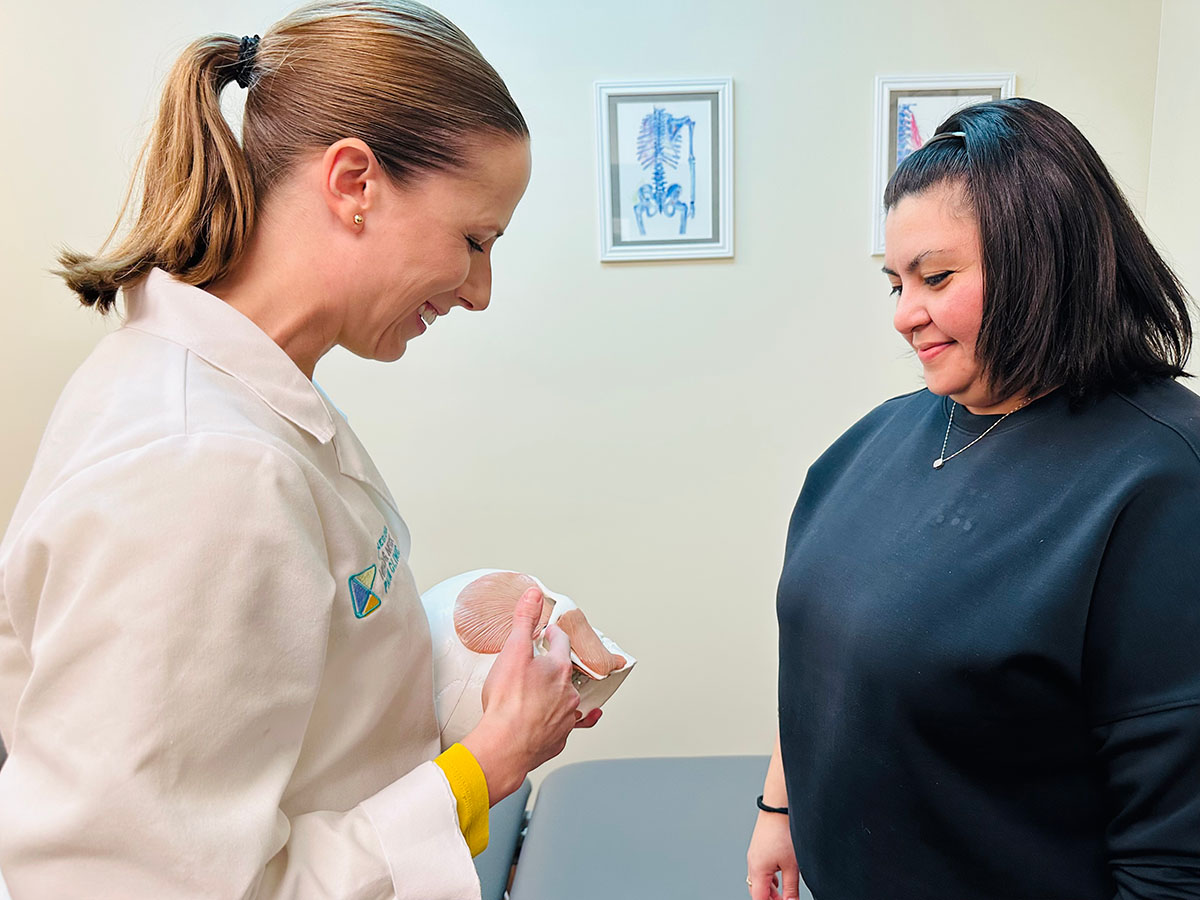
Chronic pain can be overwhelming; however, early intervention through physical therapy can prevent it from becoming more severe or debilitating.
Pain recovery typically has “ups” and “downs”. This is to be expected. On a “bad day”, many people ask themselves, “what did I do now?” The good news is that if you’re well-prepared and know what to do on a “bad day,” the pain, stress and anxiety will be less and the process will actually help your recovery. Below are some easy strategies. Work through them one at a time.
Pain Signals can be Altered by a Person’s Protective Mechanisms
Start by understanding why it’s happening: pain is like your brain’s alarm system.
Be assured; pain is normal and part of being human. Pain is a message, or a signal, transmitted from your body to your brain. It does not necessarily mean there is more injury or that things have worsened.
Sometimes when pain extends over a long time, your brain and nervous system become more sensitive. They may interpret messages as “pain” or “threatening” that previously would have been fine. What would be a stretch or ache normally, is seen by the body as danger and it registers a higher level of pain that doesn’t always match what is actually going on.
A core part of your recovery, and a specialty of physical therapists , is learning to retrain this response. By recognizing that there’s no new injury or real danger, you can help calm your nervous system and reduce unnecessary pain triggers.
Pain flare-ups are complex. A physical therapist is your expert guide who will equip you to manage them. Let’s explore how.
Your Flare-Up Action Plan, Guided by a Physical Therapist
A quick overview:
- Identify your Pain Triggers
- Embrace Physical Activity
- Pace Your Activities During a Flare-Up
- Manage Your Environment and Stress
- Hydration is Key
- Exercise Safely
- Communication and Follow-Up
Let’s get more into the detials next.
1. Identify your Pain Triggers
Physical Therapists are expert problem solvers
They will work with you to establish a pain management plan:
- Analyze patterns: They’ll help you look beyond the obvious to identify connections between your activities, stress levels, sleep patterns, and chronic pain triggers. This includes a jaw anatomy assessment.
- Develop strategies: Once triggers are identified, you can build proactive plans to manage them in the future. This can reduce the frequency and severity of flare-ups.
2. Embrace Physical Activity
It’s important to stay physically active. Take a rest when you need to, but start moving again as soon as you can. Think during your rest of you next action plan. For example, plan to do a few stretches. Or walk a little to keep moving. Movement, no matter how minimal in duration or intensity, is desirable.
Physical activity increases your body’s circullation. Circulation helps with healing and pain – so don’t stay inactive for too long.
The Journal of International Crisis and Risk Communication Research highlights the important role of a physical therapist in establishing movement techniques.
“Physical therapists can teach patients proper alignment and movement techniques to reduce strain on affected areas and prevent pain recurrence. Personalized treatment plans are tailored to each patient’s unique pain condition, ensuring the most effective pain management approach.
Unlike short-term pain relief methods, physical therapy provides tools to manage and potentially prevent pain in the future, promoting sustainable improvements rather than temporary fixes.” – Effectiveness of Physical Therapy for Chronic Pain Management
3. Pace Your Activities During a Flare-Up
Your PT can teach you to move wisely with paced activity.
“Pacing” encourages a balanced approach to pain management through activity. Be attentive to your body’s needs. Tiredness or other symptoms are easier to recover from if you take a break before they become too much.
- The “On/Off Switch”: Pacing isn’t about doing nothing. It’s about being attentive to your body and taking a break before pain or exhaustion becomes overwhelming.
- Preventing the Pain Cycle: An effective pacing strategy prevents the exhaustion of overactivity and underactivity. This active approach stops your brain from associating normal activities with pain. It doesn’t lead into an avoidance pattern. Even gentle movement, like a short walk, increases circulation and aids healing.
4. Manage Your Environment and Stress
Give yourslef permission to take a strategic retreat when needed.
It’s okay to remove yourself from stressful situations. Whether it is a troubling event that occurs, a person who is stressful to be with, or some unplanned experience, get away if you need to.
Excuse yourself for a short walk; a drink of water; or a moment of reflection. During this time, taking deep cleansing breaths may refresh you. Changing your environment can change how you feel.
This doesn’t mean avoiding what you may need to face. It means pain and stress management that you can handle.
5. Hydration is Key
Drink plenty of water. Dehydration can impact a person’s pain tolerance. if your body gets too dehydrated, or for too long a time, it can disrupt your nervous system. Nerves help to regulate pain signals.
Dehydration potentially leads to increased sensitivity and a lower pain threshold, according to Southeast Pain and Spine Care. [1] This means that a dehydrated individual might feel pain more intensely. Or find some stimuli painful that wouldn’t normally be so.
6. Your PT Helps You Exercise Safely
Often its challenging for a person to know if they are doing physical exercise the best way. Your PT will watch for proper posture and body mechanics to reduce abnormal or excessive joint loading.
With appropriate modifications, most forms of physical activity work even for people with chronic pain conditions. Our team of physical therapist know what important considerations are best for tailoring a physical activity or exercise program to your needs.
7. Communicate With Your Physical Therapist & Pain Provider
The most suitable physical therapy approaches will depend on:
- Your symptoms.
- Any specific medical problem.
- The level of your pain.
- The duration of your pain (a short time or long time).
- Your personal preferences.
- Your overall physical fitness. [2]
You don’t need to be guessing or dealing with this alone. We are here to listen and help you.
Are you wondering if this can work for you if your pain level is high?
Is Movement Therapy Effective for High-Impact Chronic Pain?
High-Impact Chronic Pain treatment also considers if the pain has persisted over a long time.
The American Osteopathic Association (AOA) June 2018 survey finds “physical therapy has been an effective treatment for 26 percent of chronic pain sufferers, and 11 percent report yoga/movement therapy as an effective pain reliever.” The Early intervention could prevent chronic pain, which affects half of all adults article talks about how pain is a personal and subjective experience.
Many people with pain experience “high-impact chronic pain,” which frequently limits life or work activities. In 2023, this figure was 8.5% of adults, according to the Centers for Disease Control and Prevention (CDC). It reported that 24.3% of adults experienced chronic pain, and 8.5% of adults experienced high-impact chronic pain (or 34.9% of adults who had chronic pain). [3]
The CDC defines “high-impact chronic pain” as pain that lasts 3 months or more and is accompanied by at least one major activity restriction. Typically, this refers to flare-ups that impact someone’s ability to work, go to school, or do household chores. PT is most critical for individuals in this group.
Start Managing New or Flare-Up Pain Today!
Chronic pain can undermine your confidence, but you have the power to change the narrative. Addressing pain early—or tackling a flare-up with a clear strategy—is the best way to prevent it from controlling your life.
Start building your personalized flare-up plan with help from the Minnesota Head & Neck Pain Clinic. Download our helpful Coping Plan for Pay Days PDF.
Book an Appointment to see a Physical Therapist
Choose our clinic location closest to where you live, call us at:
Plymouth: (763) 577-2484St. Paul: (651) 332-7474Burnsville: (952) 892-6222St. Cloud: 763-233-7252
About the author:
Dr. Leslie Hovda – Doctor of Physical Therapy. She is board certified as both an Orthopedic PT and as a Cervical and Temporomandibular Therapist. She has a passion for mentoring and teaching and has taught orofacial pain courses nationwide.
Reources:
[1] SE Pain & Spine Care, “How Dehydration Contributes to Chronic Pain,” 2024, https://www.sepainandspinecare.com/how-dehydration-contributes-to-chronic-pain/
[2] “In brief: Physical therapy,” March 2024, https://www.ncbi.nlm.nih.gov/books/NBK561514/
[3] Jacqueline W. Lucas, M.P.H., and Inderbir Sohi, M.S.P.H., “Chronic Pain and High-impact Chronic Pain in U.S. Adults” Nov 2024, https://www.cdc.gov/nchs/products/databriefs/db518.htm